
Real Estate
Mar 5, 2026
The $1.95 Trillion Glitch
Real Estate
Mar 5, 2026
We’ve been sold a story for a decade: Get your solar panels, track your Scope 3 emissions, and your asset value is protected. But in 2026, the market is hitting a wall. We are discovering that a building can have a "Platinum" rating for its carbon footprint and still be a financial disaster because it’s sitting in an uninsurable flood zone or a heat-stressed grid.
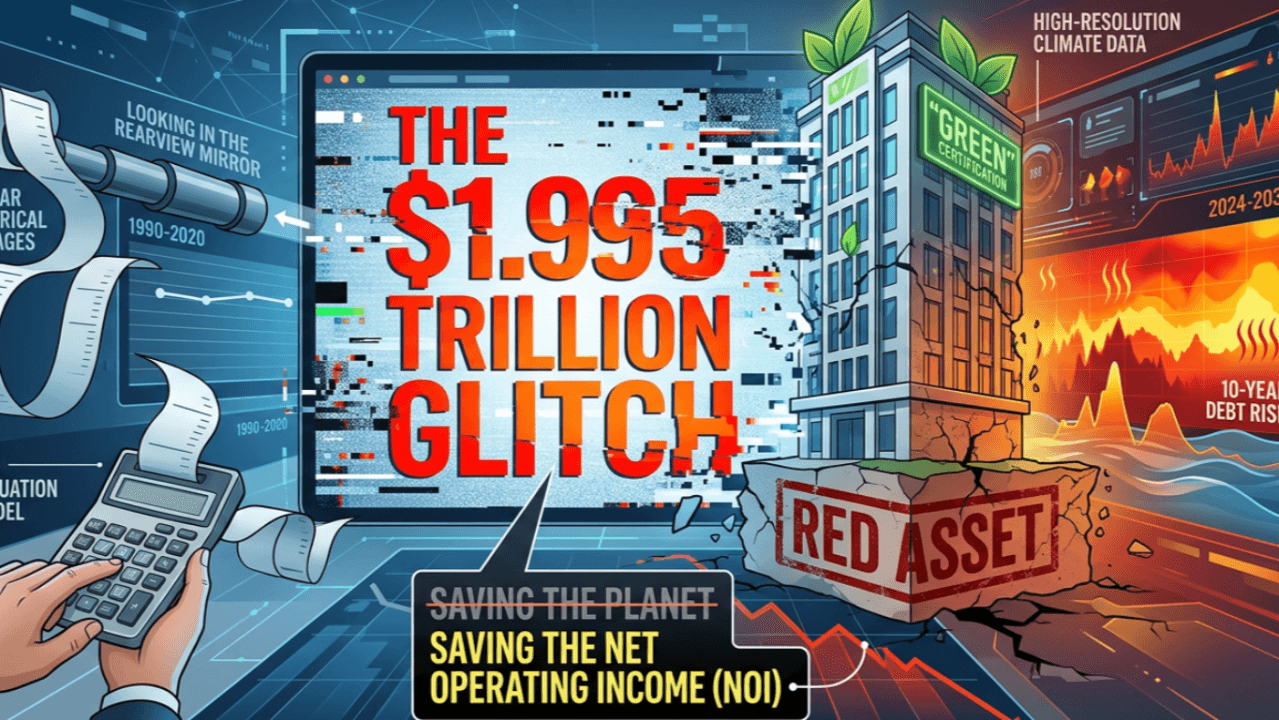
The industry is currently operating on a $1.95 trillion glitch. We have high-resolution climate data telling us the world is changing, but our valuation models are still looking in the rearview mirror, using 30-year historical averages to price 10-year debt.
It’s time to stop talking about "saving the planet" in our investment committees and start talking about saving the Net Operating Income (NOI).
"Business as Usual" isn't free anymore. It’s showing up as a quiet, relentless tax on the ledger. We aren't just talking about "The Big One" (the hurricane or the wildfire); we’re talking about the "Death by a Thousand Basis Points."
The Insurance Cliff: Major insurers are leaving Florida and California not because of "politics"—they’re leaving because the math doesn't work. When insurance premiums jump 30% in a year, that isn't an "ESG risk." That is a direct hit to your Cap Rate. (Source: Insurance Information Institute)
The Maintenance Creep: We used to plan HVAC replacements every 15 years. Now, with record heatwaves, those units are running 24/7 and dying in 10. The Urban Land Institute estimates this "extreme weather wear-and-tear" is adding over $1.00 per square foot in unplanned annual Capex. That is money straight out of the investors' pockets. (Source: ULI)
The "Brown Discount": The "due diligence" phase has changed. Buyers are bringing climate quants to the table. If you can’t prove your asset’s 10-year resilience, you’re looking at a 2% to 5% haircut on your exit valuation. Institutional capital is no longer willing to "buy the blind spot." (Source: MSCI Real Estate)
The biggest mistake we made was putting "Climate" in the ESG bucket. It belongs in the Risk & Strategy bucket.
Fiduciary duty in 2026 isn't about checking a box for a regulator. It’s about Asset Preservation. We need a "Translation Layer" that turns degrees of warming into dollars of NOI. For example:
‘Index’ the risk: A building with a reinforced sea wall is a different financial instrument than the one across the street. We need to stop "averaging" our risk and start indexing it.
Reward ‘boring’: We need to reward the "boring" stuff. The upgraded drainage, the reflective roofing, the backup micro-grid. These aren't "green features"—they are Revenue Insurance.
Price ‘climate’: If you aren't pricing the 2035 climate reality into your 2026 acquisition, you aren't "investing." You’re just gambling that you can find a "greater fool" to buy the asset before the insurance runs out.
We have enough carbon data. What we lack is financial intelligence. The winners in this cycle won't be the ones with the best "sustainability story." They will be the ones who realized that climate volatility is a pricing problem.
It’s time to stop asking, "How much carbon are we emitting?" and start asking the only question that matters for the balance sheet: "How is this environment impacting our 5-year NOI projections?"